Backward difference
The starting point: a discrete-time analogue of the first derivative. Simple, memoryless, and the building block for everything that follows.
Western Kentucky University 路 KSEF
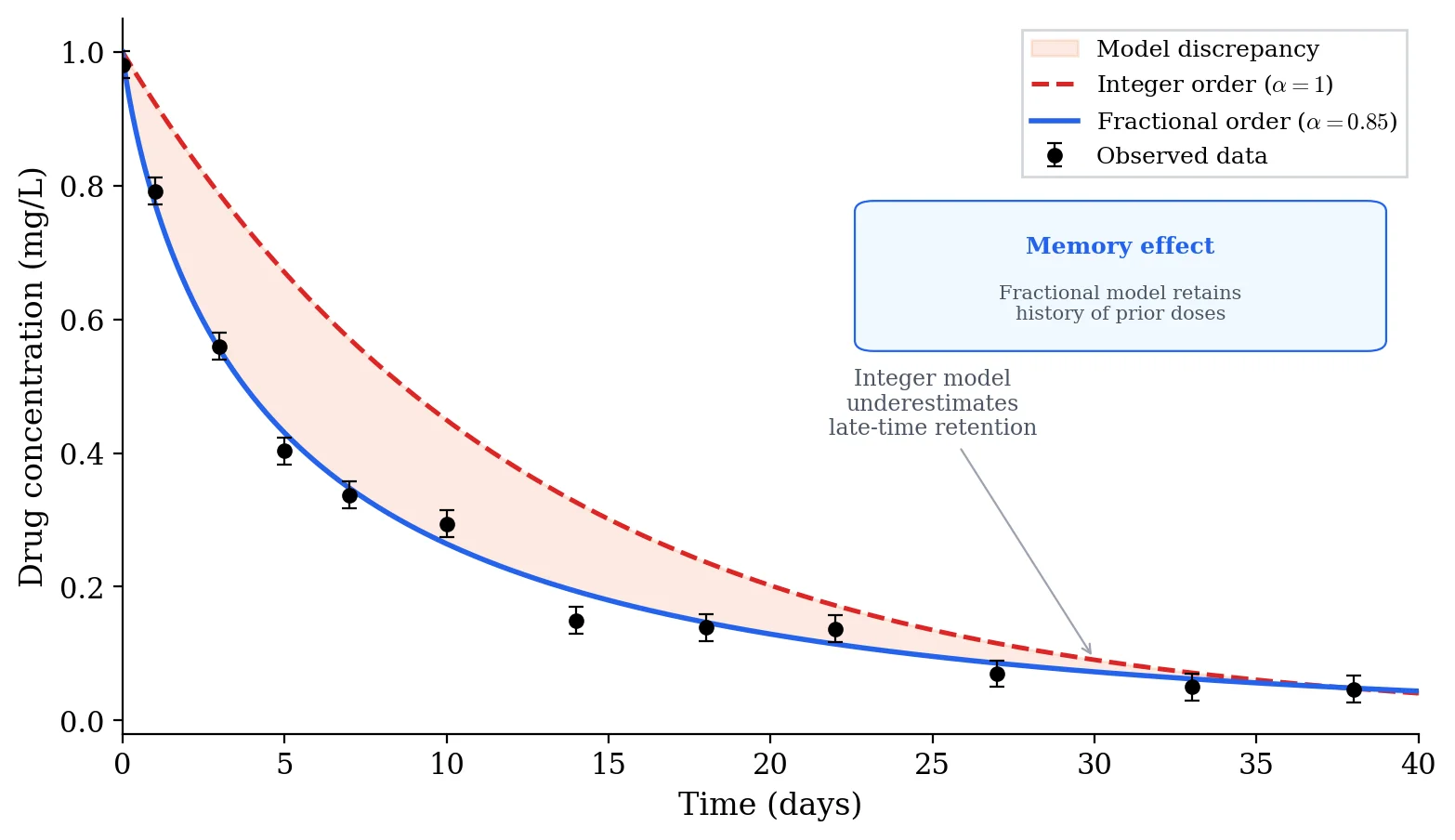
When modeling how a drug moves through the body, classical approaches assume the system has no memory: each time step depends only on the current state. But pharmacological systems often retain memory of earlier drug exposure, and ignoring this can lead to misleading predictions. In this project, we used discrete fractional calculus, specifically nabla operators, to build PK/PD models that naturally encode this history. We applied the framework to tumor growth and anti-cancer drug response.
The starting point: a discrete-time analogue of the first derivative. Simple, memoryless, and the building block for everything that follows.
This is where memory enters the picture. The fractional sum aggregates all prior states, weighted by a kernel that decays over time. Recent history matters more, but old history is not forgotten.
The key generalization: extending integer-order differencing to non-integer orders \(\alpha\). When \(\alpha = 1\) we recover the standard backward difference; fractional values give tunable control over memory depth.
To keep the mathematics clean, we work under a few assumptions:
This state-space form is our entry point for studying controllability (can we steer the system to a desired state?) and observability (can we infer hidden states from measurements?) in fractional PK/PD systems.
F.M. At谋c谋, M. At谋c谋, N. Nguyen, T. Zhoroev, G. Koch 路 Computational and Mathematical Biophysics, 2019 路 61 citations
Read the paperT. Zhoroev, F.M. At谋c谋 路 Fractional Differential Calculus, 2019 路 4 citations
Read the paperT. Zhoroev, F.M. At谋c谋 路 Fractional Differential Calculus, 2020 路 0 citations
Read the paperT. Zhoroev 路 Master's Thesis, Western Kentucky University, 2019 路 3 citations
Read the thesis